ServicesUnder-sink reverse osmosis
Under-Sink Reverse Osmosis Systems in Grand Prairie
We install a reverse osmosis unit under your kitchen sink, so drinking and cooking water passes through several filter stages. You end up with its own faucet, a neat cabinet and a single contact who answers your questions from the first call through the last wipe-down.
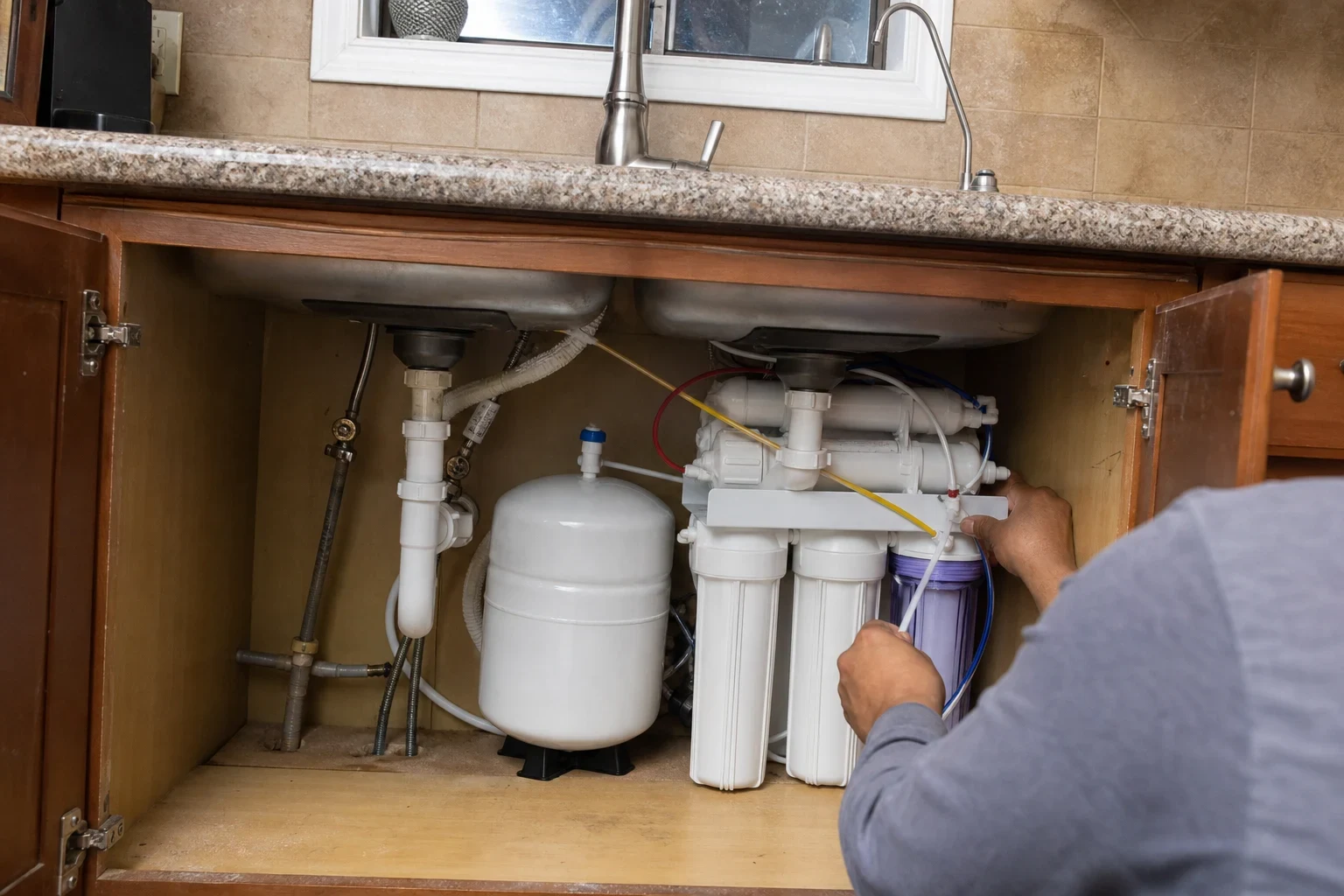
How reverse osmosis works under the sink
The system forces water through a semipermeable membrane whose pores are much finer than any pitcher filter. Dissolved salts, lead and many trace contaminants are held back and flushed to the drain, and the clean water continues to a small storage tank or directly to the faucet. Sediment and carbon stages before the membrane remove grit and chlorine, which protects the membrane and gets rid of the pool-like taste. One last carbon polishing stage sits right before the faucet.
It fits best when what matters most is the water you drink and cook with. That could be taste, lead from older pipes or fixtures, or wanting more confidence than plain tap water offers. It feeds one faucet, not the whole house. If the chlorine smell in your shower bothers you as well, whole-house carbon filtration works well alongside it.
One person takes your calls and arranges the work from estimate to cleanup, so details are not dropped between a salesperson and an installer.
What the installation includes
- A look under your sink first
- We check cabinet depth, the garbage disposal, the cold-water shutoff and where the drain runs. That tells us whether a tank fits or a tankless unit is the better choice.
- Multi-stage system
- Sediment prefilter, carbon prefilter, the membrane and a polishing filter. Where the supply uses chloramine instead of chlorine, we choose a catalytic carbon stage that handles it properly.
- Dedicated drinking faucet
- We mount the faucet in an existing sink hole or the sprayer opening when we can. If the counter needs drilling, we discuss it first and use the right bit for stone, quartz or laminate.
- Proper drain connection
- The reject line connects through a drain saddle above the trap, positioned so it stays quiet and does not pull water back.
- Optional refrigerator line
- We can run a line to your refrigerator's water dispenser or ice maker so filtered water reaches those too.
- Flush, test and tidy
- We flush the new filters, check every fitting for drips, and leave the cabinet organized with the shutoffs easy to reach.
Signs an under-sink system makes sense
You buy bottled water
Cases of bottles in the pantry usually mean the tap isn't trusted. A reverse osmosis faucet replaces most of that.
Chlorine taste in coffee and tea
Disinfectant flavor carries into anything brewed. The carbon stages remove it before the water reaches your cup.
Older plumbing or fixtures
Lead and copper can come from household pipes and solder, not the city main. Reverse osmosis is one of the most effective ways to reduce them at the faucet you drink from.
A pitcher filter that never keeps up
If you're refilling a pitcher several times a day, a plumbed system gives you filtered water on demand.
Cloudy ice or spotty glassware
Dissolved minerals show up in ice cubes and on dried glasses. Filtered water at the sink and fridge helps with both.
What moves the price
Every kitchen is a little different, so we quote after seeing yours. The main drivers are the system itself and how much work the space and connections take. Your written estimate lists each item so there are no surprise additions on the day.
Tank or tankless
A traditional system with a storage tank is compact and economical. A tankless unit frees up room beneath the sink and sends less water down the drain, though its initial price is higher.
Faucet mounting
Using an existing hole is simple. Drilling through granite or quartz takes more time and care.
Fridge or ice maker hookup
Feeding filtered water to the refrigerator means more tubing, a few more fittings and time spent routing the line neatly through cabinets or along the floor.
Water pressure
Reverse osmosis works best with good pressure. If your home runs low, a small booster pump may be recommended.
Condition of the shutoff
An old valve that won't close fully should be replaced before we connect anything, and we'll tell you before we do.
How the job runs
- 1
Start with a phone call
Describe what you notice in your water and how the space under your sink is laid out. When the question is one only a lab can answer, we may point you to water testing before recommending any equipment.
- 2
Written estimate
After seeing the sink, we write out the system, faucet, any extra lines and labor as separate lines, so you know what you're paying for.
- 3
Installation day
We lay down a mat, clear and protect the cabinet, shut off the cold line and install the system. Most kitchens are back in use the same visit.
- 4
Walkthrough and cleanup
We show you the shutoff, where each filter sits and how to tell when one is due. Then we clean the cabinet and counter and take our packaging with us.
Common questions about under-sink RO
How much water does reverse osmosis send down the drain?
Every system drains some water to keep the membrane rinsed. Newer and tankless models waste much less than older ones. We tell you the ratio for the unit we suggest so you can make a fair comparison.
Is there room for it next to my garbage disposal?
Most of the time. Tankless units suit tight cabinets, and a tank can often go off to one side. We check the fit under your sink before you agree to anything.
Will it take out minerals and change how the water tastes?
It removes most dissolved minerals, and many people say the water tastes clean and crisp. If you prefer a fuller taste, a remineralization cartridge can put a little calcium and magnesium back.
How much maintenance does it need?
Prefilters and the polishing filter are typically changed once or twice a year, depending on how much water your household uses. The membrane lasts much longer. If you would rather not track it, our filter replacement and maintenance service can keep the schedule for you.
Do I need a water test before installing?
Not always, but it is useful when you have a particular worry such as lead or iron. Testing shows whether reverse osmosis is enough by itself or whether iron and sediment filtration should go in first.
Let's plan the water you drink
Describe your kitchen and your drinking water. A call gets you a free water test and a free quote for a system that fits.